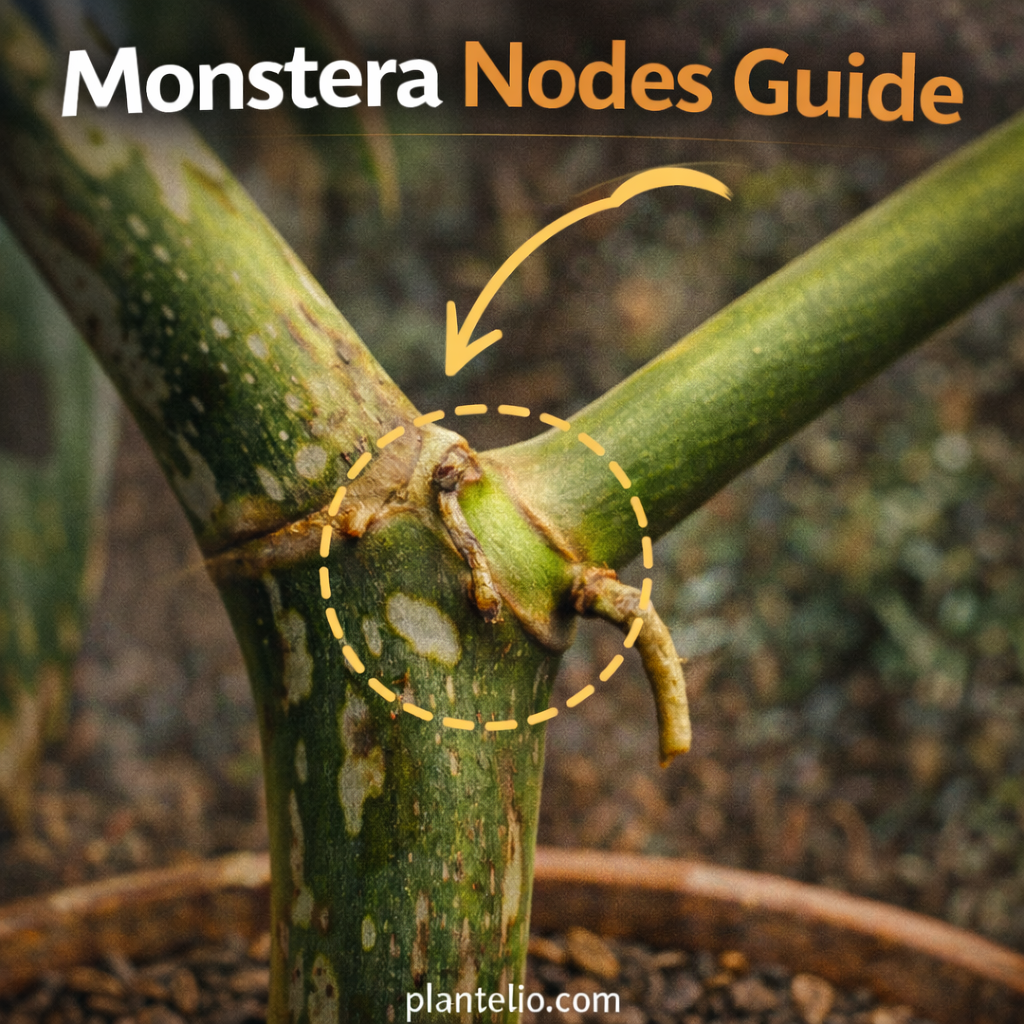
Monstera Nodes Guide: What Are Monstera Nodes and How to Find Them
This guide is for identifying the parts of a Monstera deliciosa stem before taking or buying a cutting. The key distinction is between a leaf stalk and a piece of main stem that includes a node and an axillary bud. If those parts are unclear, pause before cutting.
Trace a leaf back to the stem
Follow the leaf blade along its stalk, called the petiole, to the point where it joins the main stem. That attachment point helps locate the node. The length of stem between two nodes is an internode. Aerial roots and buds should be interpreted in relation to that stem structure, rather than treating every visible bump as the same part.
- Leaf blade
- The broad part of the leaf; it is not the main stem.
- Petiole
- The stalk connecting the blade to the stem.
- Node
- A point on the main stem where a leaf develops.
- Internode
- The stem section between nodes.
- Axillary bud
- The growth point to identify and retain when choosing suitable propagation material.
Use the labelled propagation map in the University of Minnesota Extension guide to compare these structures with a photographed plant. A text description cannot confirm the anatomy of an unseen cutting.
A photograph checklist before cutting
- Take one image showing the whole stem section and leaf attachments.
- Take a closer image from another angle if a structure is hidden.
- Mark the main stem, petiole, proposed node and bud on a copy of the photograph.
- Mark the intended cut so you can check what remains on each side.
- Compare with a labelled reference before proceeding.
Do not scrape, cut or peel tissue just to make the photograph easier to interpret. If you cannot locate the relevant structures confidently, keep the plant intact and seek help using the photographs.
When considering a purchased cutting
| Question | Why the answer matters |
|---|---|
| Is main stem included? | A detached leaf and stalk are not equivalent to a viable stem cutting. |
| Can the node and bud be identified? | A vague “rooting point” label does not show what the material contains. |
| Is the section firm and intact? | Deteriorating tissue calls for a different assessment from a healthy cutting. |
| Are these photographs of this cutting? | A parent plant’s photograph cannot verify the material being supplied. |
A large leaf, a long aerial root or the name of a rare cultivar does not replace the anatomical check. Avoid making a purchase decision from a parent plant’s appearance alone.
Identification is not a success guarantee
A suitable node and bud are essential considerations, but rooting and subsequent growth also depend on the condition and management of the cutting. A photograph of the correct structures does not guarantee that the material survives.
Once the material is identified, use the propagation guide for the rooting setup and follow-up. If the tissue is soft or deteriorating, review the root and deterioration investigation before treating it as routine propagation.
Reference
The botanical distinction and node requirement are described by University of Minnesota Extension: Monstera deliciosa. The photograph and purchase checklists organize the evidence to inspect; they are not a remote certification of a cutting.

Post Comment