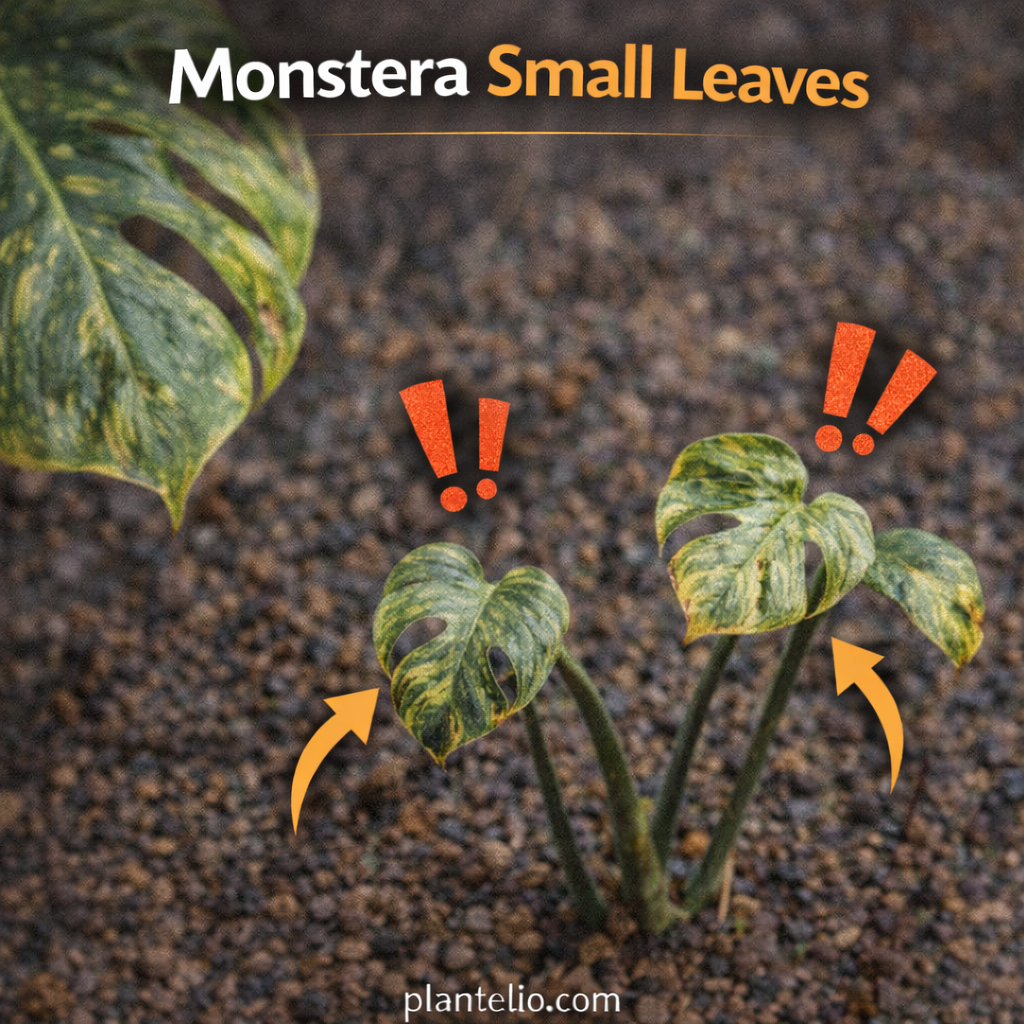
Monstera Small Leaves: Why Monstera Leaves Stay Small and How to Fix It
A small Monstera leaf is not automatically a care failure. Start by separating a young plant with consistently small leaves from an established plant whose latest leaves are becoming smaller. Those patterns call for different investigations.
Compare the right leaves
Identify the plant as accurately as possible. Plants sold under similar common names can have different growth habits. Then compare fully opened leaves on the same growing stem. A newly unfurling leaf is not a reliable finished-size comparison, and a fresh cutting should not be judged against the largest leaf on its parent plant.
Take a photograph with a ruler beside the leaf without bending it. Note the date, stem and whether the leaf is fully open. Repeat this for later leaves. A simple series is more useful than comparing your plant with a specimen photographed under different growing conditions.
Use the growth pattern to decide where to look
| Pattern | First check | Avoid this shortcut |
|---|---|---|
| Small but otherwise healthy leaves on a young plant | Plant identity and development stage | Assuming that every small leaf needs fertilizer |
| Progressively smaller leaves after a move | Light at the new position and changed watering demand | Making several care changes at once |
| Small leaves with long gaps between leaves | Whether light is adequate | Placing the plant abruptly in strong direct sun |
| Small leaves alongside persistent wilting or yellowing | Root-zone moisture and drainage | Repotting into a much larger container without inspecting the roots |
| Small new growth after cutting or repotting | The timing and condition of the new growth | Expecting the next leaf to match the old specimen immediately |
Investigate light with observations
Light affects indoor plant growth and leaf development. Record where the plant sits, what blocks the window and how the light changes through the day. Window direction alone cannot describe the conditions at a leaf. A plant behind a curtain or far from a window may receive a different amount of light from one beside the same window.
If the position is unsuitable, improve it gradually and record the move. Protect the plant from a sudden jump into harsh sun. Evaluate subsequent growth instead of expecting mature existing leaves to change size. The light guide gives the broader care context.
Check water and roots before adding fertilizer
Review whether the mix repeatedly becomes completely dry or remains wet while the plant declines. Leaf size alone cannot tell you which is occurring. Use the dry-pot checklist or wet-pot checklist when those observations fit.
A small leaf also cannot establish a particular nutrient deficiency. Record the fertilizer product, dilution and last application. Follow its houseplant directions and consider whether the plant is actively growing. Adding extra feed to a stressed plant is not a dependable way to make the next leaf large.
Support the climbing stem without promising a result
Monstera deliciosa is a climber. A stable support can help manage its stem as it grows, but installing a pole does not guarantee a particular leaf size. Identify the main stem and leaf stalks before fastening anything; do not bind a leaf stalk tightly or force the plant into a new position. Check attachments as growth continues.
Choose repotting on evidence about the root system and container, rather than the desired leaf size. More potting mix can also change the drying pattern, so the old watering routine may need reassessment after a container change.
Measure progress without chasing a deadline
- Record the current leaf sequence and growing conditions.
- Investigate the most plausible issue from the whole pattern.
- Correct that issue and record exactly what changed.
- Compare later, fully opened leaves from the same stem.
- Reassess if the plant develops new damage or continues to decline.
Improvement is a trend in healthy growth, not a guaranteed leaf dimension or a fixed number of weeks. Small leaves with firm stems and stable colour are a different situation from small leaves accompanied by rapid deterioration.
References
For the species’ climbing habit, see NC State Extension: Monstera deliciosa. For environmental influences, see University of Maryland Extension: Lighting for Indoor Plants and Fertilizer for Indoor Plants. The comparison checklist is a way to organize your observations, not a remote diagnosis.











2 comments