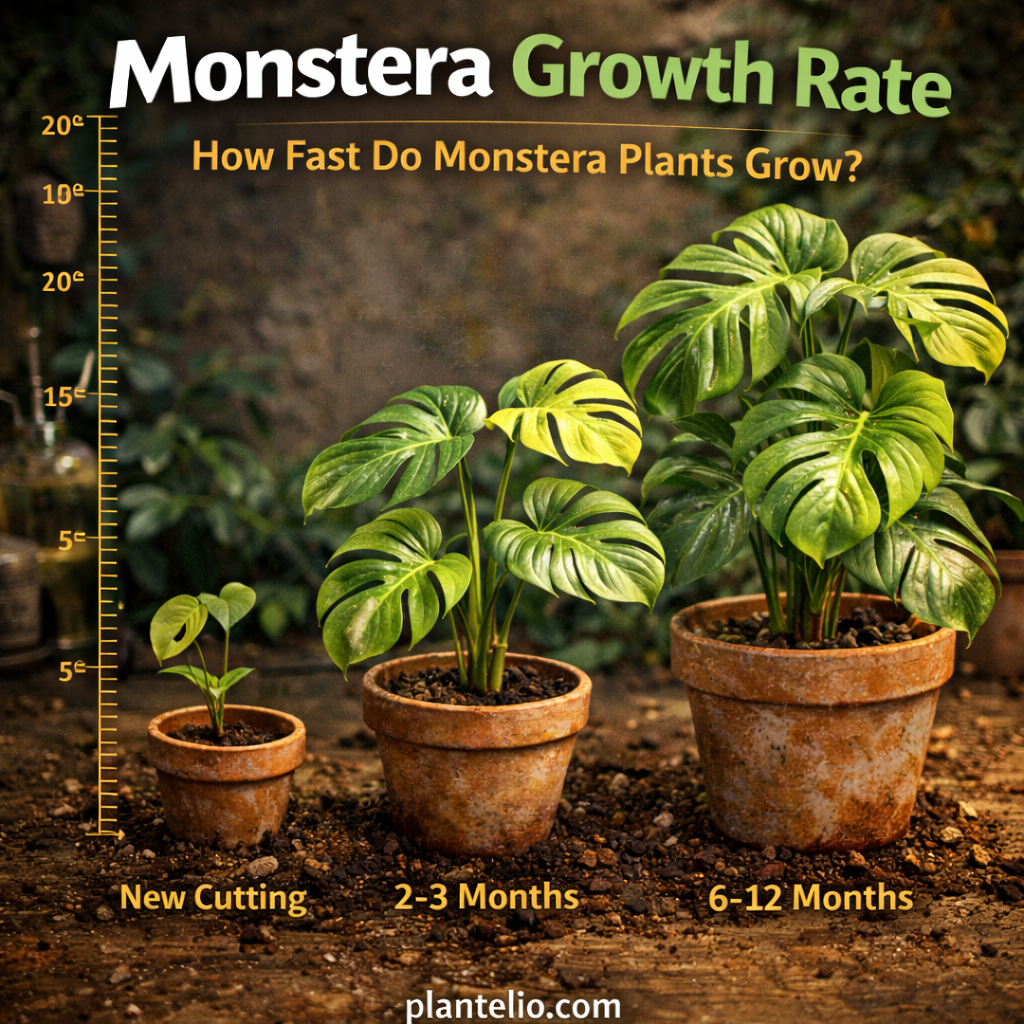
Monstera Growth Rate: Measuring Leaves and Stem Growth at Home
Measure your Monstera’s growth with a consistent definition before comparing it with a monthly leaf count online. New leaf production, leaf size, stem extension and apparent height are different measurements. A plant moved onto a taller support can look larger without having produced that much new stem.
Choose what you will measure
| Measurement | How to record it | What it does not establish |
|---|---|---|
| New leaves | Count newly fully opened leaves on identified stems over dated intervals. | The growth of roots or the size of every leaf |
| Leaf size | Compare fully opened blades on the same stem using one method. | The plant’s overall height or a nutrient diagnosis |
| Stem extension | Use the same marked reference points in photographs or measurements. | A simple comparison with the height of a differently trained plant |
| Apparent height | Record the support and plant arrangement as well as height. | How much new tissue was produced after a rearrangement |
Keep different stems separate where possible. A new offshoot and an established climbing stem can make a whole-plant leaf count difficult to interpret if their identities are lost between checks.
Count over a stated observation period
Write a start date and an end date, and define “new leaf” consistently. For example, count a leaf when it is fully opened rather than counting it once when emerging and again when opening. A photograph series helps resolve uncertainty about which leaf was counted.
In a hypothetical record, stem A produces three fully opened leaves during a 90-day observation. That describes three observed leaves in 90 days. Dividing gives an average of one per 30 days for that period, but it does not predict that the next leaf arrives in exactly 30 days or that 12 leaves will appear next year.
Record conditions beside the numbers
Add notes for a move, repotting, cutting, support change or fertilizer application. A growth count without those events can invite misleading comparisons. If the plant was cut, start a clearly labelled sequence rather than treating the new configuration as the same uninterrupted stem.
Light influences indoor plant growth. Record the actual position and exposure instead of using “east window” as the whole description. The light survey helps organize this, and the leaf-size worksheet covers that separate measurement.
Compare like with like
A different species, cultivar, plant stage or growing setup is not a controlled comparison. A specimen in a greenhouse and one in a home can have very different conditions. An age label also cannot tell you exactly when a plant will develop a particular leaf shape or size.
Use your own sequence to ask whether the pattern changed, then review the conditions. Do not treat a published monthly count as a pass mark requiring extra fertilizer or a larger pot when your plant produces fewer leaves.
Distinguish slow growth from deterioration
A stable plant with no newly opened leaf during one observation period is a different situation from one with wilting, soft tissue or continuing leaf damage. If deterioration accompanies the growth pause, investigate the condition rather than waiting for the next scheduled count.
Use the watering checklist for moisture decisions and the root inspection guide when a persistently wet, declining root zone warrants investigation. Growth numbers alone cannot identify a root disease.
Keep the result useful
Save the definition, dates, photographs and condition notes with the care log. Report the observed interval when asking for help. “No new fully opened leaves on stem A between these dates” gives more information than “it grows too slowly.”
Reference and scope
For background on environmental influences, see University of Maryland Extension: Lighting for Indoor Plants. The counting example is arithmetic and illustrative; it is not a personal trial, a species-wide growth standard or a prediction.

4 comments