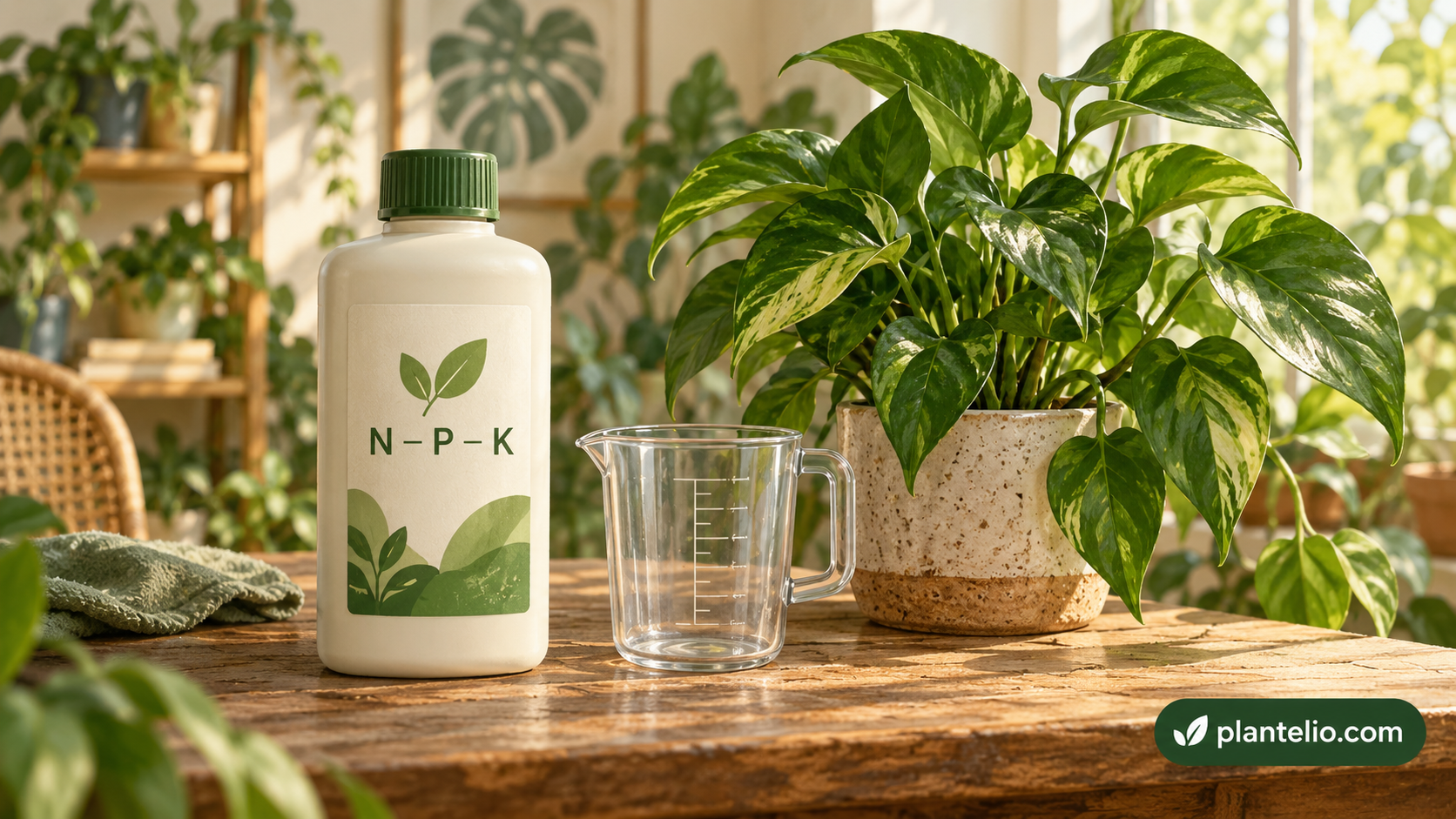
How to Read a Houseplant Fertilizer Label
A houseplant fertilizer label contains several different instructions. The large nutrient numbers describe the product, while the directions explain how to use it. Reading only the front of the bottle can leave out the detail that matters most: the amount to apply to your particular plant.
Identify the product before choosing a dose
Start with its intended use. Look for instructions covering houseplants or your particular plant group. Then establish whether you have a ready-to-use liquid, a concentrate, a soluble powder or a slow-release product. A measuring cap from a different bottle is not a substitute for the instructions on this one.
The University of Maryland’s indoor fertilizer guidance advises mixing products according to their labels. It also notes that some labels offer different concentrations for different application frequencies. Read the dose and interval together rather than combining the stronger dose from one option with the more frequent interval from another.
Understand what the three numbers mean
Under the common US fertilizer labeling convention, the three numbers express percentages by weight of nitrogen, phosphate and potash, in that order. Maryland’s fertilizer basics guide explains this analysis. A hypothetical 6-3-3 and 12-6-6 share a ratio, but they do not contain the same percentages. Neither set of numbers is a mixing recipe.
Check the actual label used in your country, including the nutrient names and units. Do not translate the middle number directly into a spoonful recommendation or assume a larger number means a better choice.
Copy the directions into a usable note
- Exact product name and formulation.
- Plant group covered by the instructions.
- Product amount and water volume, where dilution is required.
- Application interval and any stated conditions.
- Date last applied and any fertilizer already added to the mix.
Keep a photo of the original directions alongside this note in your plant care log. If a unit or instruction is unclear, resolve it with the manufacturer before estimating.
Separate feeding from troubleshooting
A label explains product use; it does not diagnose a declining plant. Maryland warns that excessive fertilizer can lead to salt accumulation. Review recent care and check soil moisture before treating a yellow leaf as a request for more fertilizer. Match feeding to the plant’s needs and growing conditions rather than adding it simply because another watering is due.











Post Comment