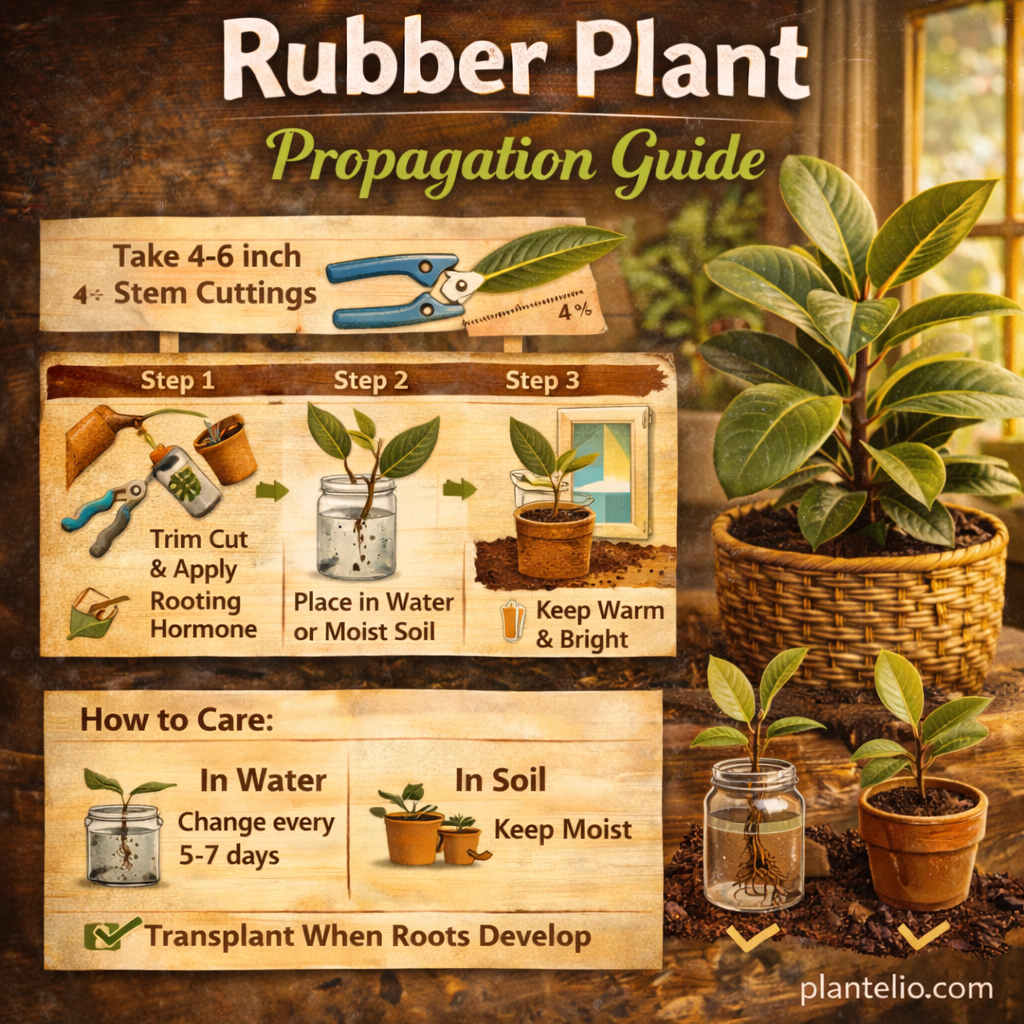
Rubber Plant Propagation Guide: How to Propagate Ficus Elastica
Rubber Plant Propagation Guide (Ficus Elastica)
Rubber plants (Ficus elastica) are beautiful and easy-to-grow houseplants known for their large glossy leaves. One of the most rewarding parts of owning a rubber plant is the ability to propagate it and grow new plants from cuttings.
In this complete rubber plant propagation guide, you’ll learn the most effective propagation methods, including stem cuttings and air layering. These techniques allow you to multiply your plant and share it with friends or expand your indoor jungle.
When Is the Best Time to Propagate Rubber Plants?
The best time to propagate rubber plants is during the spring and summer growing season. During this period, plants grow actively and produce roots much faster.
Propagation during winter is possible but usually slower because plants enter a semi-dormant phase.
Method 1: Rubber Plant Propagation by Stem Cuttings
Stem cuttings are the easiest and most common propagation method.
Steps
- Choose a healthy stem with at least one leaf.
- Cut a 10–15 cm (4–6 inch) section below a node.
- Remove the lower leaves.
- Dip the cut end in rooting hormone (optional).
- Plant the cutting in moist soil or water.
Roots typically begin developing within 3–6 weeks.
Method 2: Rubber Plant Propagation in Water
Water propagation allows you to observe root development easily.
Steps
- Place the cutting in a glass of clean water.
- Ensure the node is submerged.
- Change water every few days.
- Place the container in bright indirect light.
Once roots reach about 5 cm (2 inches), transfer the cutting to soil.
Method 3: Air Layering (Advanced Method)
Air layering is another popular technique for rubber plant propagation, especially for large mature plants.
Steps
- Make a small cut on the stem.
- Apply rooting hormone.
- Wrap the cut with moist sphagnum moss.
- Cover with plastic wrap.
- Wait for roots to develop.
Roots usually form within 4–8 weeks.
Best Conditions for Successful Propagation
To increase the success rate of rubber plant propagation, maintain ideal conditions:
- Bright indirect light
- Warm temperatures (18–27°C / 65–80°F)
- Consistently moist but not soggy soil
- High humidity
Common Propagation Problems
Cuttings Rotting
This usually happens when the cutting stays too wet or receives insufficient airflow.
No Root Growth
Low temperatures or insufficient light can slow root development.
Leaves Dropping
Leaf loss is common after cutting but new growth should appear once roots form.
How Long Does Rubber Plant Propagation Take?
Rubber plant cuttings usually develop roots within 3–8 weeks. Growth speed depends on temperature, light, and humidity.
FAQ
Can rubber plants grow from cuttings?
Yes. Rubber plants propagate easily from stem cuttings taken during the growing season.
Is water propagation better than soil?
Both methods work well. Water propagation allows you to observe root growth, while soil propagation can produce stronger roots.
Do rubber plants need rooting hormone?
Rooting hormone is optional but can speed up root development.
How long does rubber plant propagation take?
Most cuttings develop roots within 3–8 weeks depending on growing conditions.









1 comment