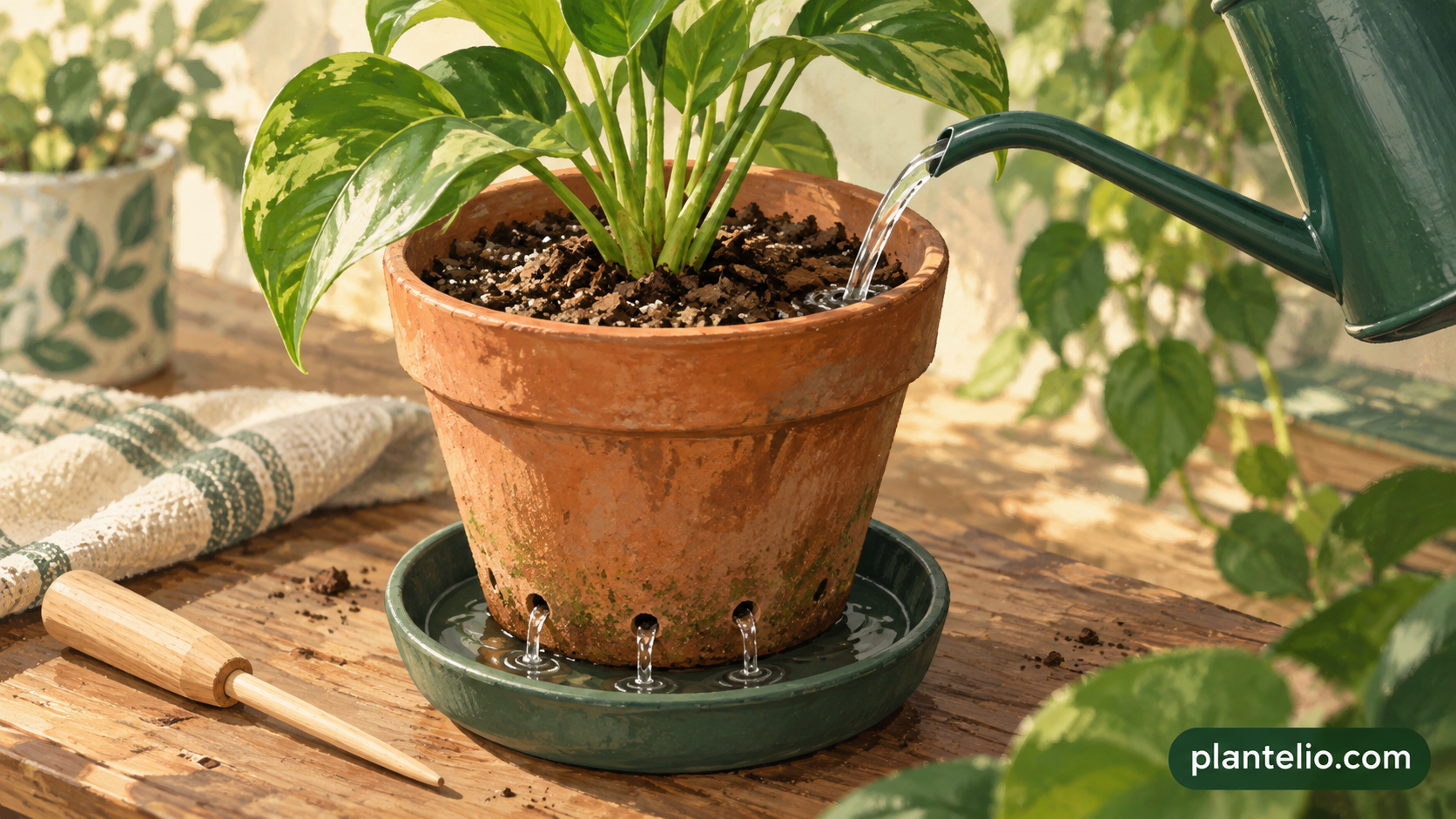
Why Water Runs Straight Through Potting Mix
Water appearing below a pot quickly does not prove that the whole root ball has been watered. Before adding more, check what is happening inside the container. The useful distinction is between water passing through an already moist mix and water bypassing a dry center.
Check Before Repeating the Pour
Lift a small pot safely and compare its weight with your usual after-watering impression. Check moisture below the surface without forcing a finger or probe through roots. Our soil moisture guide explains how to combine these observations.
Write down where you poured and where runoff appeared. Look for a visible gap between the mix and the pot wall. These observations are clues; none is a complete diagnosis on its own. Avoid deciding that the drainage holes need blocking simply because water exits quickly.
Possibility One: Very Dry, Shrunken Mix
University of Maryland Extension notes that growing medium which has dried and pulled away from the container sides may require several applications of water to rehydrate. If this describes your pot, apply water in stages and reassess absorption instead of assuming the first runoff means the job is finished. Allow drainage and empty the collecting saucer. Source: Overwatered Indoor Plants
Possibility Two: A Crowded Root Ball
A dense mass of roots is another possibility. Maryland Extension describes pot-bound plants in which water passes through quickly while the center remains dry. Inspect the root ball when it can be removed safely; do not diagnose crowding from runoff speed alone. If confirmed, repotting and attention to the tight root mass may be needed. Source: Pot-Bound Indoor Plants
For a pothos, use the Pothos repotting guide alongside that inspection. A watering problem and a need for more root space are related questions, but they are not interchangeable.
What If the Mix Is Already Wet?
Stop adding water just to slow the runoff. Record the moisture condition and investigate any continuing wilt or decline separately. Excess moisture can damage roots and cause symptoms that resemble drought; additional watering can therefore be the wrong response.
After the next necessary watering, repeat the same checks. A useful result is a root ball that has taken up water appropriately for the plant, with runoff removed. Speed at the drainage hole is only one part of that assessment.












Post Comment