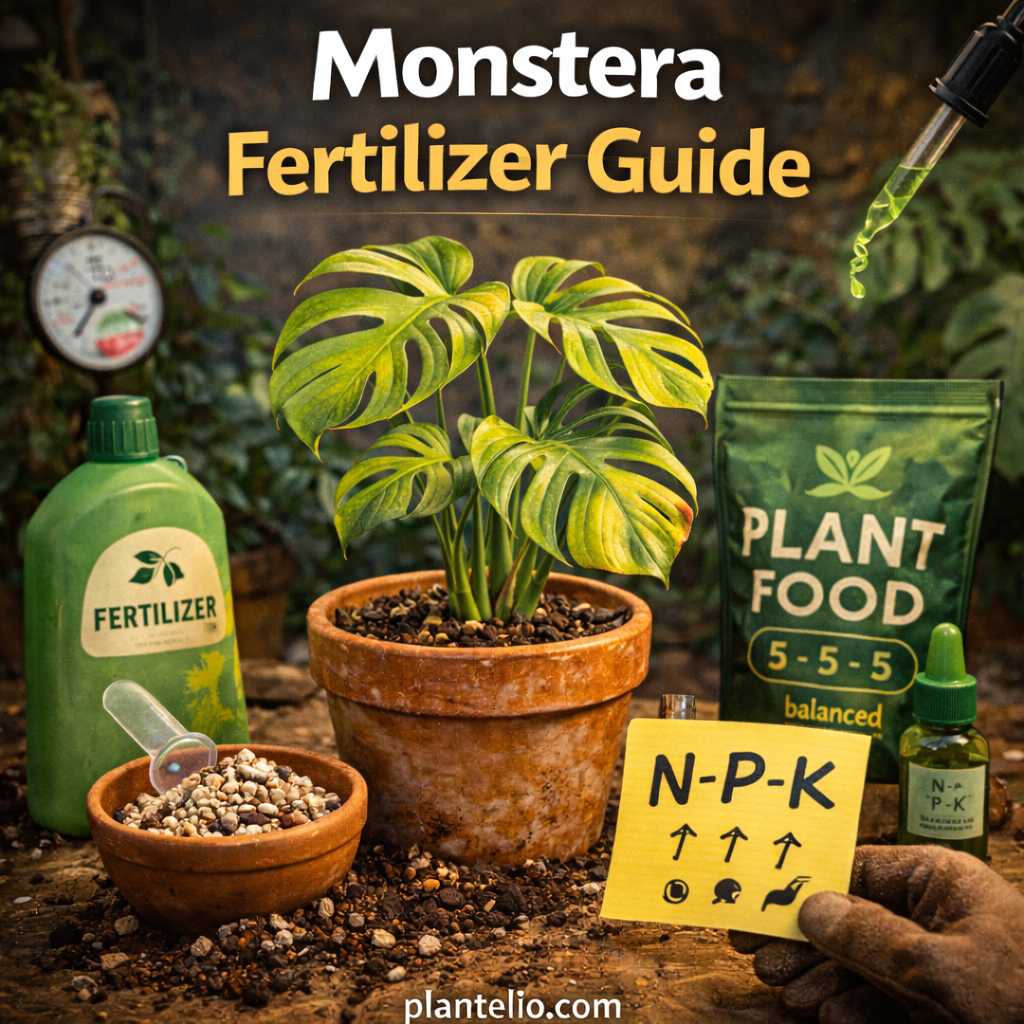
Monstera Fertilizer Guide: Reading Labels, Measuring and Tracking Feeding
Fertilizer decisions should begin with the product label, the growing medium and the plant’s condition. A universal ratio, half-strength rule or monthly calendar cannot account for every formulation and indoor setup. This guide helps you measure an application and keep enough information to investigate later changes.
Check whether feeding is the next action
Review current growth and the root-zone conditions before adding fertilizer. A small leaf, yellowing or slow growth is not a diagnosis of nutrient deficiency. Check light, moisture and drainage first if the plant is struggling. Start with the main care guide when the wider setup has not been reviewed.
Read the medium’s label for fertilizer already included and review past applications. Granules, a liquid feed and fertilizer supplied in the medium can overlap. A new product should not enter the routine without accounting for what is already being used.
Read the specific label
- Is the product intended for houseplants or the stated growing use?
- Is it a concentrate, a ready-to-use liquid or a dry formulation?
- Which dose and interval apply to that use?
- How should it be measured and applied?
- What precautions, storage instructions and restrictions are listed?
A fertilizer’s NPK numbers describe its analysis; they are not a universal Monstera prescription. Compare products using the full application instructions rather than assuming two products with similar ratios should be measured or repeated in the same way.
Measure instead of estimating
Use a suitable measuring tool and a known water volume when the product requires dilution. Write the dose down before mixing. Avoid “one cap” unless the label specifically defines that cap as its measure. Keep different products separate unless their instructions explicitly allow the intended combination.
As a purely arithmetic example, if a hypothetical label specifies 2 millilitres per litre, a 500-millilitre batch at that labelled concentration contains 1 millilitre of product. This is not a recommended Monstera dose: use the actual label for your product and intended application.
Keep an application record
| Field | Example of what to record |
|---|---|
| Product | Name, formulation and a photograph of the label |
| Instruction used | The label section applicable to houseplants |
| Mixture | Measured product amount and water volume |
| Application | Date, plant identifier and method |
| Existing fertilizer | Medium additives or earlier applications |
| Follow-up | New growth, new damage or a change in condition |
For ready-to-use products, record that no dilution was required if that is what the label says. For dry products, retain the relevant mass or container instructions instead of translating them into an invented liquid dose.
When the plant changes after feeding
Record the timing and inspect the whole plant. University of Maryland Extension describes excessive fertilizer concentration or frequency as causes of high soluble salts; associated damage can include tip or margin browning, wilting and reduced growth. Those symptoms still overlap with other problems.
A white crust is a reason to review deposits and application history, not permission to diagnose every issue as fertilizer burn. Do not respond by adding another feed. Compare moisture and drainage, confirm what was applied and seek help if the plant continues to deteriorate.
Do not flush by an arbitrary stopwatch rule
If excess salts are the identified problem, management depends on the container and medium. Maryland Extension discusses leaching or replacing affected medium in different situations. A fixed “run water for two minutes” instruction does not describe how much water passed through your pot or whether it could drain.
Review the source’s management guidance and the condition of the roots before choosing an intervention. A container without working drainage or a persistently wet, declining root zone needs a wider assessment. The root inspection guide and yellow-leaf checklist help organize those observations.
Reassess the next application
Use active growth, the medium and product instructions to review the feeding decision. Do not resume simply because an invented recovery interval has elapsed. Keep the record with the plant care log so later changes can be compared with actual applications.
References
University of Maryland Extension: Fertilizer for Indoor Plants and Fertilizer Toxicity or High Soluble Salts in Indoor Plants. This guide provides a measurement and decision framework, not a product-specific dose recommendation.










Post Comment