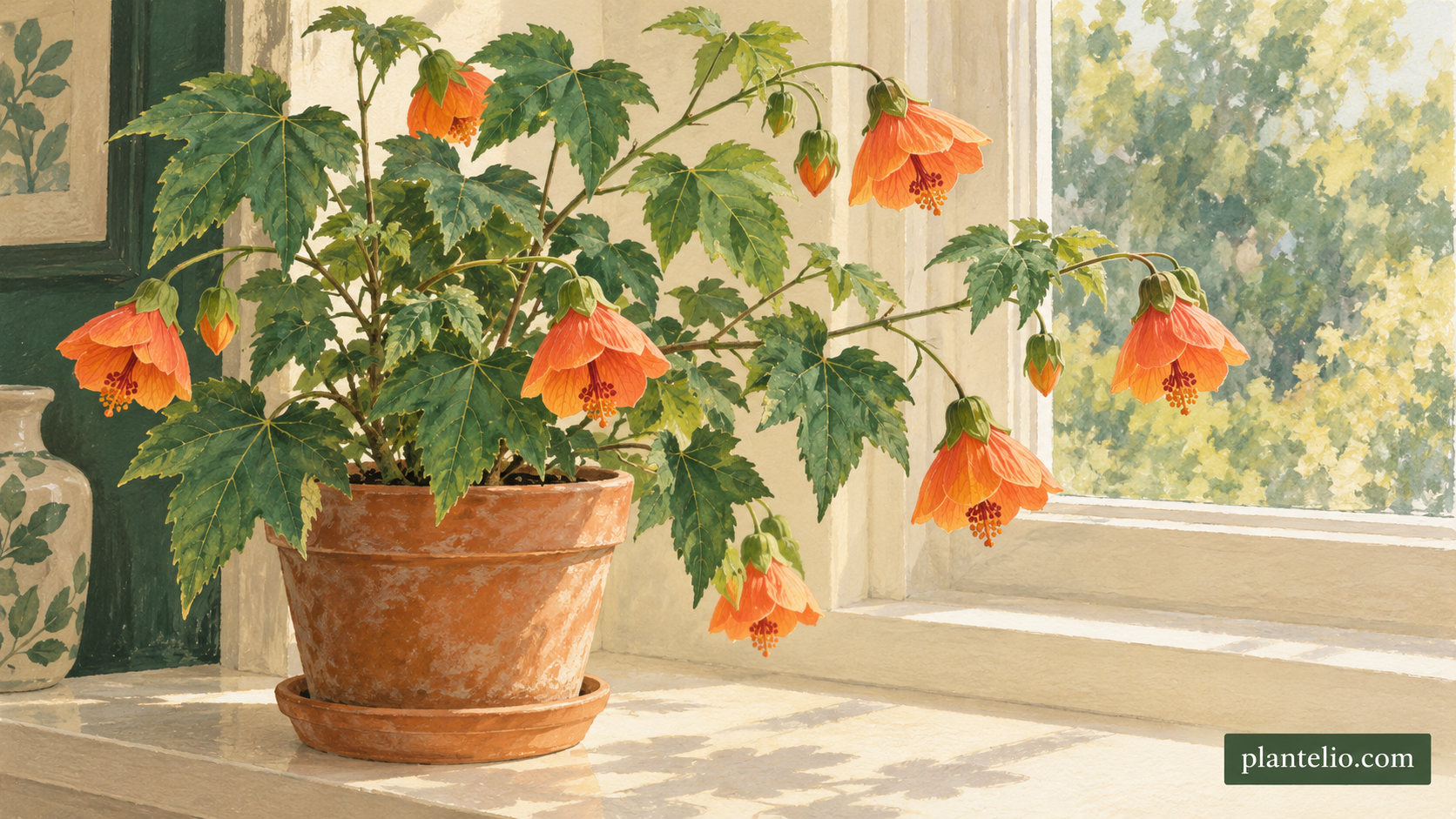
Flowering Maple Care: Growing Abutilon Indoors
Flowering maple care is for Abutilon, a tender plant with hanging bell-shaped flowers and maple-like leaves. It belongs to the mallow family, not the maple tree genus. Cultivars differ in flower color, leaf markings, and size, so keep the nursery label when choosing a plant for a window.
Find a bright position
Indoors, flowering maple needs a bright, sunny window. A leafy specimen in a dark corner should not be expected to flower like one grown in strong light. Use our home light guide to describe your current location, then assess whether the plant receives the stronger light this flowering subject needs.
Wisconsin Extension recommends relatively cool indoor conditions, around the 60s Fahrenheit. Protect the plant from frost. Record the actual temperature beside the pot, rather than relying only on a thermostat elsewhere in the room.
Water without prolonged drying
Use rich, well-drained compost and keep it consistently moist during active growth. Flowering maple struggles when allowed to become too dry. In winter, reduce watering as growth slows, but do not let the entire root ball dry completely.
Before adding water, check moisture in the pot. Write down what you found and whether drainage was clear. This creates a practical record for your particular container instead of an automatic weekly watering rule.
Pinch for a manageable shape
Young shoots can be pinched to encourage bushier growth and stronger stems. Flowers form on new growth. For an indoor plant that has outgrown its space, spring pruning can help control size; leave room for the fresh shoots that follow.
Handle the branches gently because they can be brittle. Before moving the container, clear a route and lift the pot itself rather than pulling a branch away from neighboring plants.
Inspect before treating
Look beneath leaves and around shoot tips for aphids, mites, thrips, or whiteflies. North Carolina State also lists root rot among possible problems. Photograph anything suspicious and identify it before selecting a treatment; a pest name on a care sheet does not mean every declining plant has that pest.
Sources: University of Wisconsin–Madison Extension; NC State Extension Abutilon profile.










Post Comment