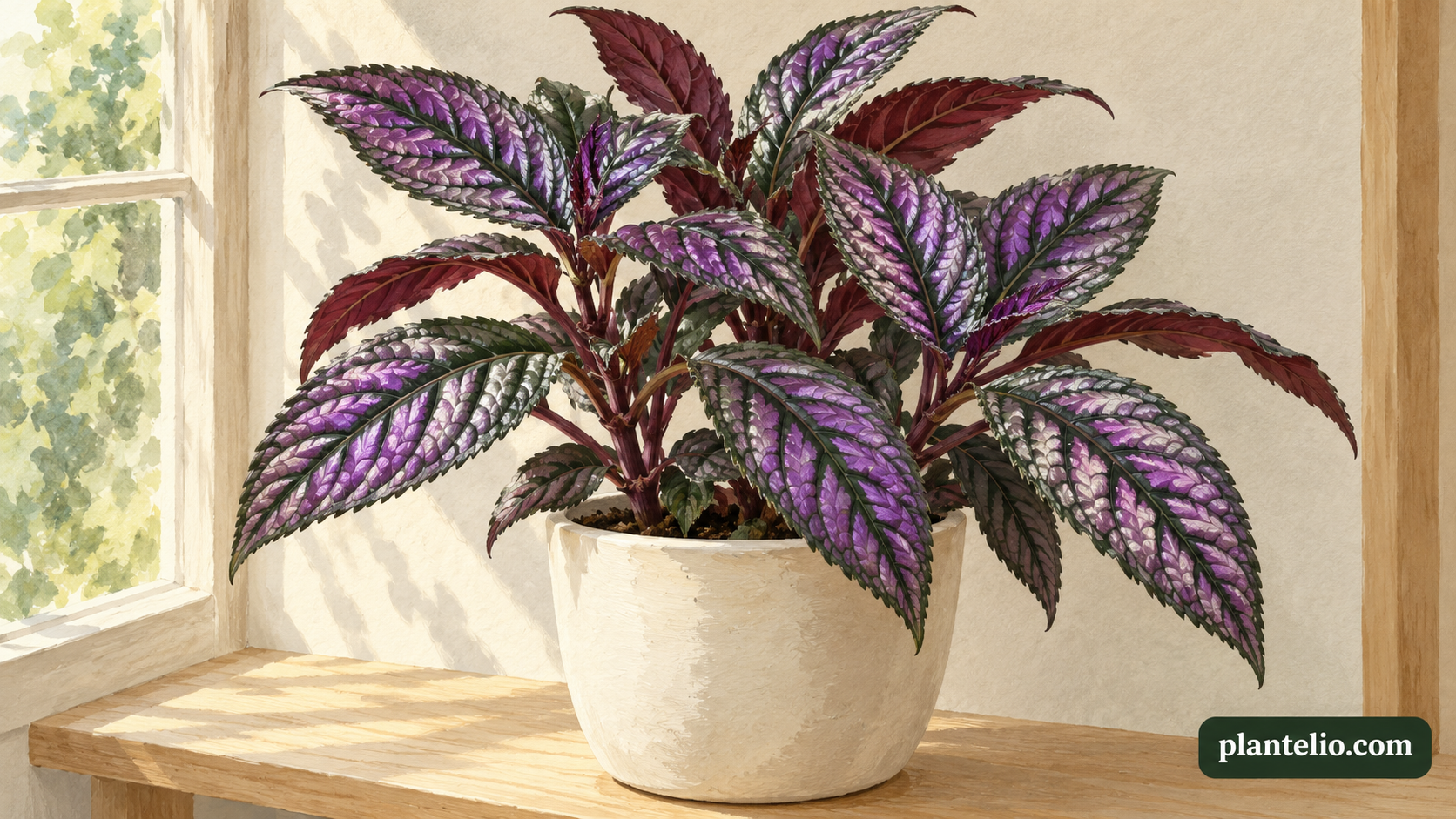
Persian Shield Care: Keeping Purple Foliage Growing Well
Persian shield care should support healthy new growth rather than chase an identical shade of purple on every leaf. Strobilanthes dyeriana is a tender shrub with a metallic sheen, prominent veins, and purple leaf undersides. It can become a substantial plant even though it starts as a small pot of colorful foliage.
Start with bright, protected light
The RHS recommends full light under glass with protection from hot sun. For an indoor plant, look for a well-lit position where strong sun does not bake the foliage. Our guide to bright indirect light explains what to look for at the plant’s actual height.
Outdoor recommendations vary with climate. Wisconsin Extension notes that northern gardens can use more sun, while plants in southern regions benefit from partial shade. Avoid transferring that advice to a hot window without checking the conditions.
Keep moisture and drainage together
Use a potting medium that retains moisture but drains well. Wisconsin Extension recommends moist soil rich in organic matter; the RHS specifies a peat-free, loam-based compost for protected cultivation.
Before adding water, use these soil moisture checks. If the mix remains wet, another watering is not the next step. Check whether runoff can leave the pot and whether a decorative container is holding it.
Shape young growth
The RHS advises pinching young growth to encourage a bushier plant. Decide how much room you have before cutting: a broad plant may suit a floor stand better than a narrow shelf.
Wisconsin Extension reports that older plants develop woody stems and can lose some foliage color. A less vivid older leaf therefore does not identify a nutrient deficiency by itself. Compare the newest growth, light conditions, and recent care before changing fertilizer.
Consider cuttings as a renewal option
Softwood tip cuttings can root in water or a moist medium. Use healthy, non-flowering growth; Wisconsin Extension notes that flowering stems are unsuitable for this purpose. Keep the original plant’s label with any cuttings so that its identity remains clear.
Sources: University of Wisconsin Extension: Persian shield; RHS: Strobilanthes dyeriana.


Post Comment