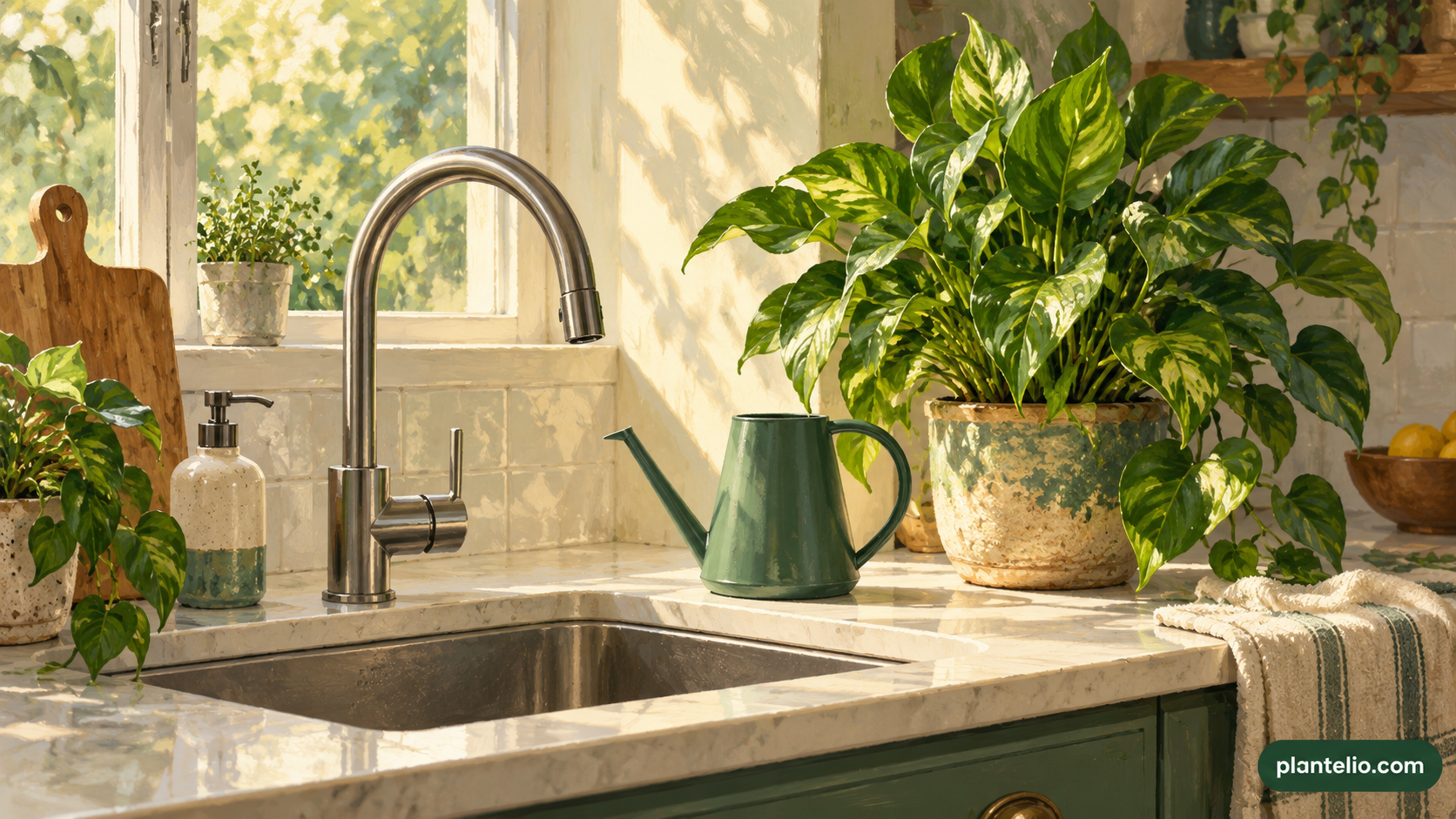
Can You Water Houseplants with Softened Water?
If your home has a water softener, check the supply you use for houseplants before treating every tap as equivalent. The useful first question is whether that particular tap receives softened water. Do not assume the kitchen, utility room and outdoor outlets share the same plumbing route.
Why the water source matters
Iowa State University Extension notes that heavily softened water can contribute to salt buildup in potting mix, particularly in plants that are not repotted often. That makes the treatment history relevant when reviewing a plant’s care.
This does not mean every brown leaf tip proves a water-quality problem. Record what you know before changing the routine: which tap you use, whether the water passes through treatment equipment, and how long you have used it. A photograph of a leaf cannot identify the composition of the water.
Identify the tap, not just the appliance
Look for the softener’s documentation and ask the installer, building manager or household member who knows the plumbing which outlets are treated. If there is a verified untreated supply, check whether it is suitable for the particular plant. Do not alter unfamiliar plumbing or bypass settings simply to test an assumption.
Labels such as “filtered” and “softened” describe different processes. A filter jug’s presence does not tell you which dissolved substances it removes. Read the product information or ask its manufacturer rather than assuming any filter solves the issue.
Choose a source with a clear reason
For an identified sensitive plant, consult species-specific guidance before choosing an alternative. Iowa State notes that distilled water may suit highly mineral-sensitive plants such as many carnivorous species. That is not a reason to require it for every plant in an ordinary collection.
Write down the source you decide to use in your plant care log. If you buy water, keep the label information so you can repeat the choice. Avoid switching among several sources while simultaneously changing light, fertilizer and potting mix; the observations become difficult to interpret.
Review the rest of the routine
Water quality is one part of care. Check drainage, watering decisions and fertilizer use too. Our fertilizer-label guide helps you verify the product and dose rather than adding more feed in response to unexplained symptoms.
If symptoms continue, take a clear history to a local extension service or qualified plant adviser. Include the plant identity, water-treatment details and recent care changes. Ask what additional information is needed instead of choosing a treatment from leaf colour alone.











Post Comment