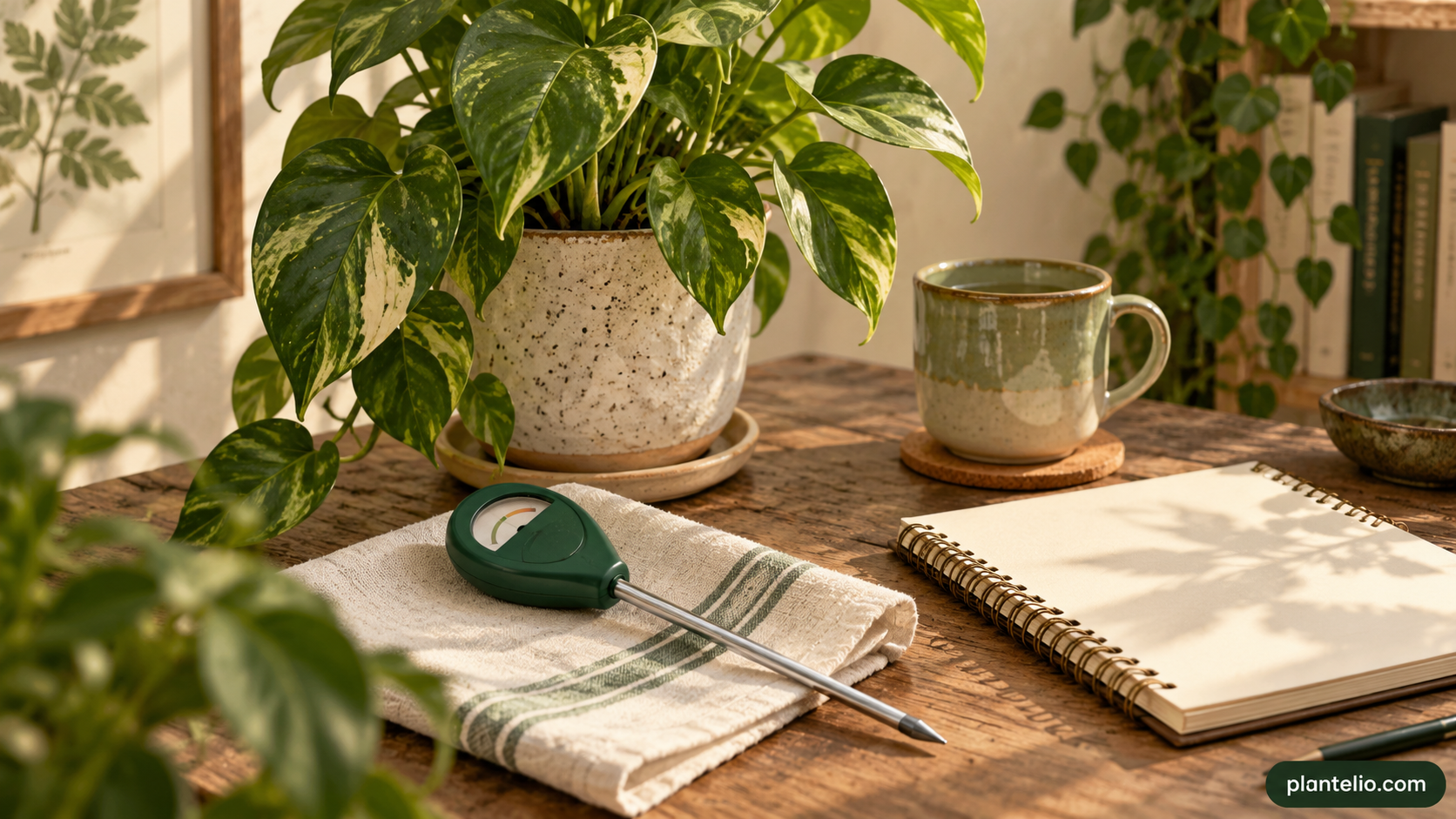
How to Cross-Check a Houseplant Soil Moisture Meter
A soil moisture meter can make you pause and inspect a pot before watering. Its reading should support that inspection rather than replace it. Start with the plant’s needs and the instructions for the particular device you own.
Understand what the scale claims
University of Illinois Extension describes water-meter probes as potentially useful but not always reliable. A dial marked dry, moist and wet is not a universal watering prescription for every species or growing medium.
Read the manual for supported materials, insertion depth, reading time and cleaning. Check whether the device is intended to remain in the pot or to be removed after use. Do not assume advice for another brand applies to yours. A combined light, moisture and pH device may also have a mode selector; confirm which function you are reading.
Compare within one familiar pot
Choose an accessible plant whose watering needs you understand. Note the container and mix. Use our guide to checking moisture before watering for a separate physical check and, if the pot is safely liftable, a weight comparison.
Follow the meter instructions, then record the reading beside what you observed. Repeat during ordinary care rather than deliberately overwatering or drying out a plant to test the device. The goal is to learn whether the tool provides a consistent, useful clue in that container.
Do not force a probe through resistance
Choose a position where you can insert the probe gently as directed. Stop if you meet resistance; roots, supports or the container itself may be in the way. Do not use the probe as a lever or push harder just to reach a preferred depth.
Keep the device’s handling and cleaning requirements nearby. If readings become unexpected, inspect the probe and consult its manual before deciding that the plant needs more water.
Resolve disagreement before acting
- If the dial says dry but your independent check finds damp mix, pause and recheck the method.
- If the dial says wet while the pot feels unusually light, verify placement and the device’s instructions.
- If a plant wilts, inspect the conditions; wilting alone does not establish that the root zone is dry.
Record the disagreement in a plant care log. Include the pot, date, reading, physical observation and action. If the meter repeatedly conflicts with better-supported observations, stop using its number as the trigger for watering and seek help interpreting the device.










Post Comment