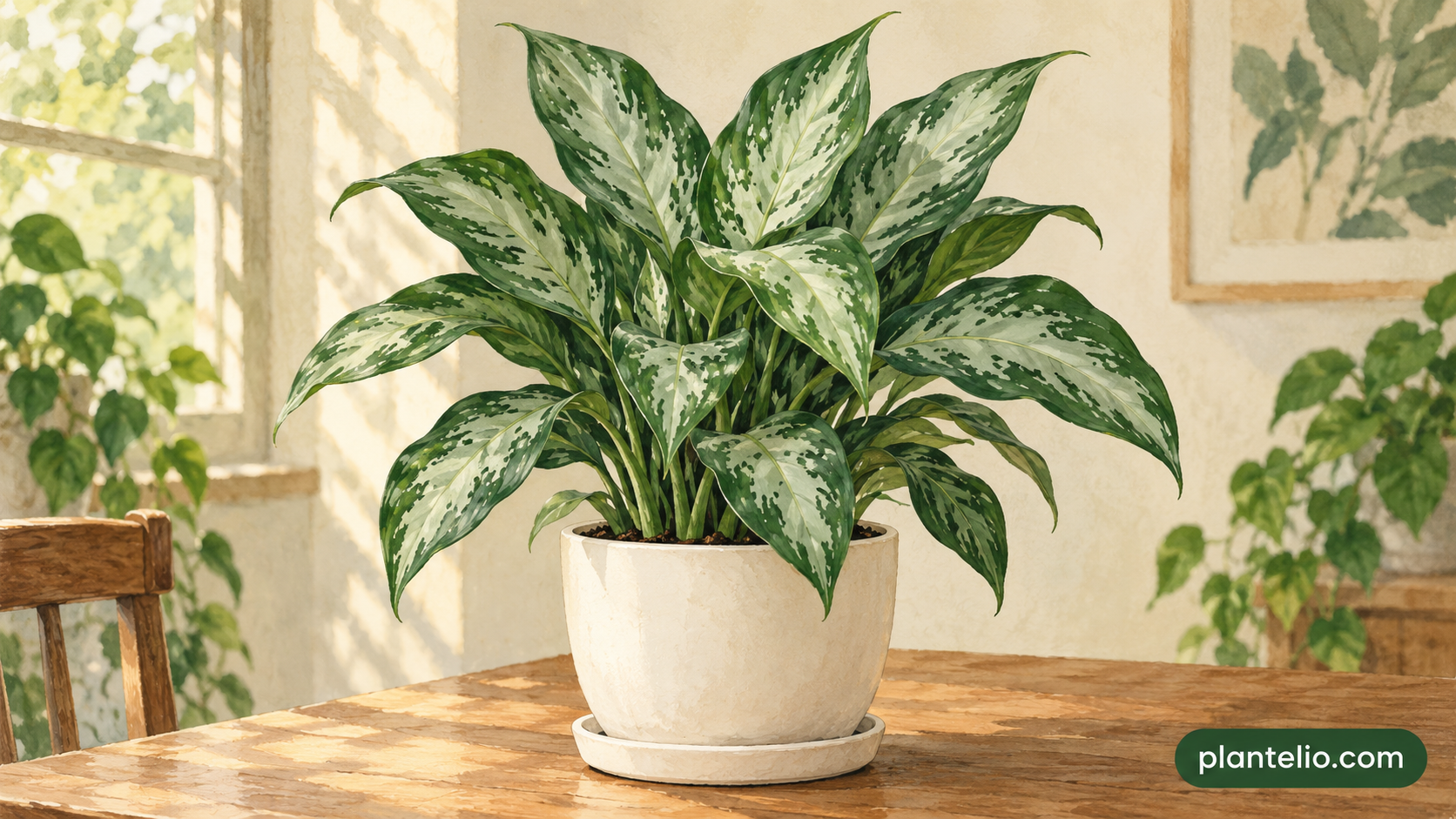
Aglaonema Care: Choosing a Home for Chinese Evergreen
Aglaonema care starts with choosing a workable location for the plant you actually own. Chinese evergreens come in many leaf patterns and colours, so retain the cultivar label instead of treating every plant with that common name as identical. This guide covers the genus broadly and gives you a starting routine to refine with cultivar-specific information.
Record identity and normal colour
NC State Extension’s Aglaonema profile describes numerous species and cultivars, including green, silver, pink and red foliage. Keep a whole-plant photograph and a close view of a normal leaf beside the label.
That small record prevents later confusion about whether a pale patch is part of the pattern or a new change. Do not assign a cultivar name purely because a photograph online looks similar; record uncertainty if the shop label is incomplete.
Choose indirect light and a protected position
NC State recommends diffuse or good indirect light and describes Aglaonema as suitable for lower-light indoor positions. It also warns that these plants are intolerant of cold temperatures.
Use our indirect-light guide to assess a candidate location. Look at the space the foliage will occupy, then check whether you can inspect and water the plant there comfortably. An attractive display is easier to maintain when you can reach the pot.
Build watering around observations
The NC State profile recommends moist growing conditions during the growing season with reduced winter watering, but also warns about root rot from overwatering and advises allowing drying between applications. The practical aim is to avoid continually saturated medium, not to follow a rigid seasonal calendar.
Use our moisture-checking guide and record the individual pot’s condition before deciding to water. Note any location change alongside the watering record. That makes it easier to compare what happened before and after a move.
Include household access in the placement decision
NC State lists calcium oxalate crystals and warns that ingestion or contact with the sap can cause harm. Keep the plant out of reach of children and pets that may chew it, and avoid handling the sap.
Choose a stable location that meets both the plant’s conditions and your household’s needs. If those requirements cannot be met on the proposed shelf, reconsider the location before bringing the plant home.
Investigate specific changes
When a concern appears, identify which leaves changed and when, and compare with your original photographs. Combine that information with the recent moisture and location notes. A clear record gives you a better starting point than treating every difference in leaf colour as a request for another product.










Post Comment