Button Fern Care: Round Leaflets and a Well-Drained Pot
Button fern care should match the plant’s identity. This guide covers the compact New Zealand fern commonly sold as Pellaea rotundifolia. NC State lists it as Hemionitis rotundifolia, with Pellaea as a previous name. Keep both names in your notes when comparing care information.
Recognize its compact form
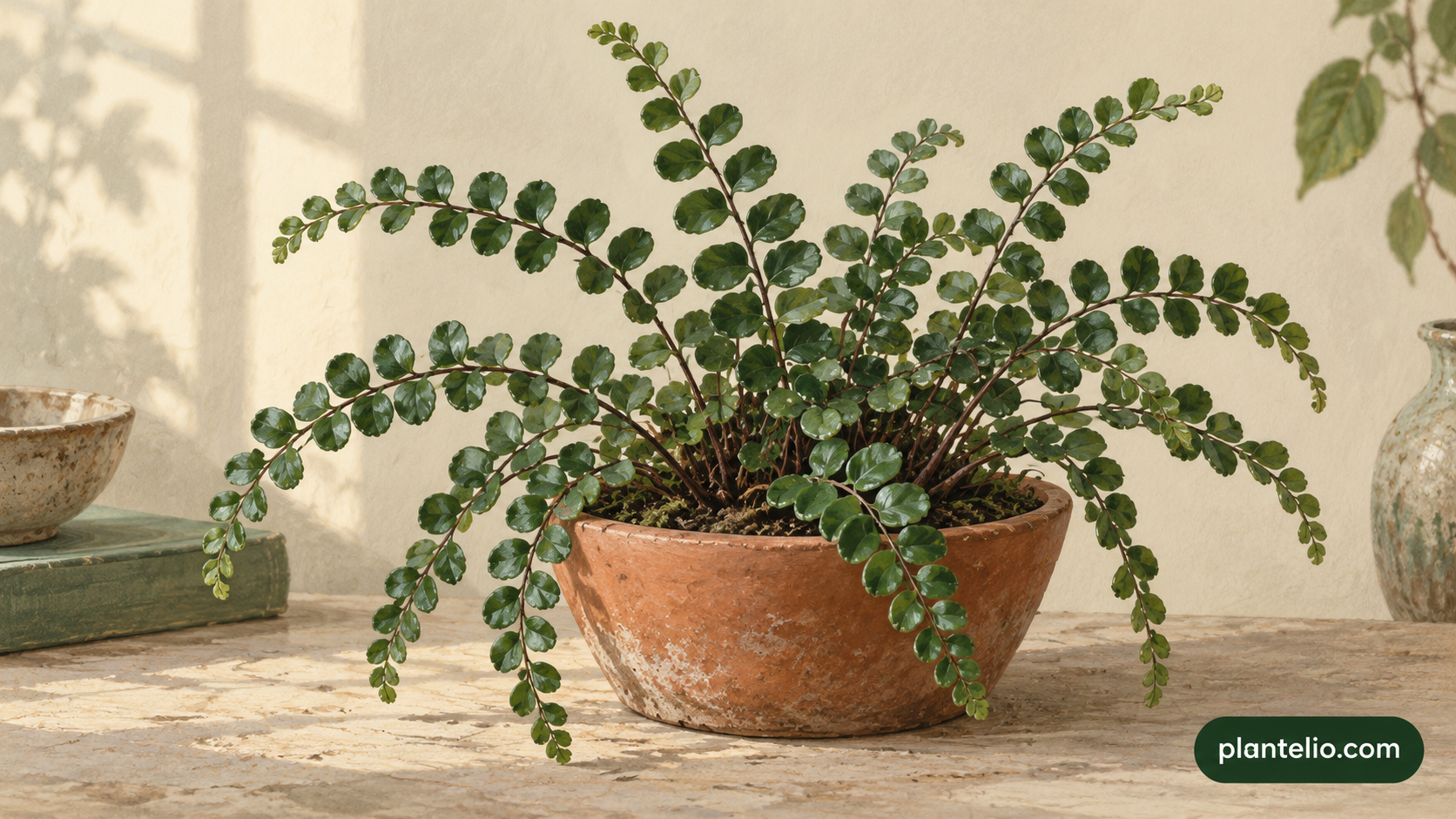
RHS describes a low rosette of fronds with rounded, dark green leaflets on dark stems. The fronds reach roughly 25cm (10in) long. This small, spreading form differs from the long, feathery fronds many people picture when they hear “fern.”
Choose a container position that lets you see the center of the plant. A shelf filled tightly with neighboring foliage can make it harder to notice changes or reach the potting surface.
Use filtered indoor light
NC State recommends indirect or subdued light indoors. RHS also notes protection from hot midday sun in its cultivation guidance. Our bright indirect light guide can help you identify a filtered position without treating shade tolerance as a reason to use an unlit room.
Provide drainage, not a swamp
NC State emphasizes good drainage and an acidic, humus-rich growing medium. RHS similarly describes moist but well-drained conditions. Neither recommendation means leaving the root zone permanently saturated.
Use our soil moisture checking methods before adding water. Check the medium rather than deciding from the rounded leaves alone. A small container and a larger one may dry at different rates even when both hold the same fern.
Do not assume every fern needs identical humidity
NC State notes that button fern does not require the humid conditions preferred by many other ferns. That makes it worth considering separately from more moisture-sensitive species when choosing a plant for an ordinary room. It still needs appropriate root-zone care.
RHS includes it among plants suitable for terrariums and bottle gardens. That is a possible display option, not a requirement to enclose every specimen. Choose a setup you can inspect and maintain rather than adding an enclosure automatically.
Keep routine tidying simple
RHS advises removing old foliage as it dies rather than regular shaping. Preserve healthy fronds and allow the natural low, arching form to develop. When comparing two plants, check their botanical labels before assuming different leaflet shapes represent a care problem.
Sources: NC State Extension: button fern; RHS: Pellaea rotundifolia.










Post Comment