Strawberry Begonia Care: Leaves, Runners and Baby Plants
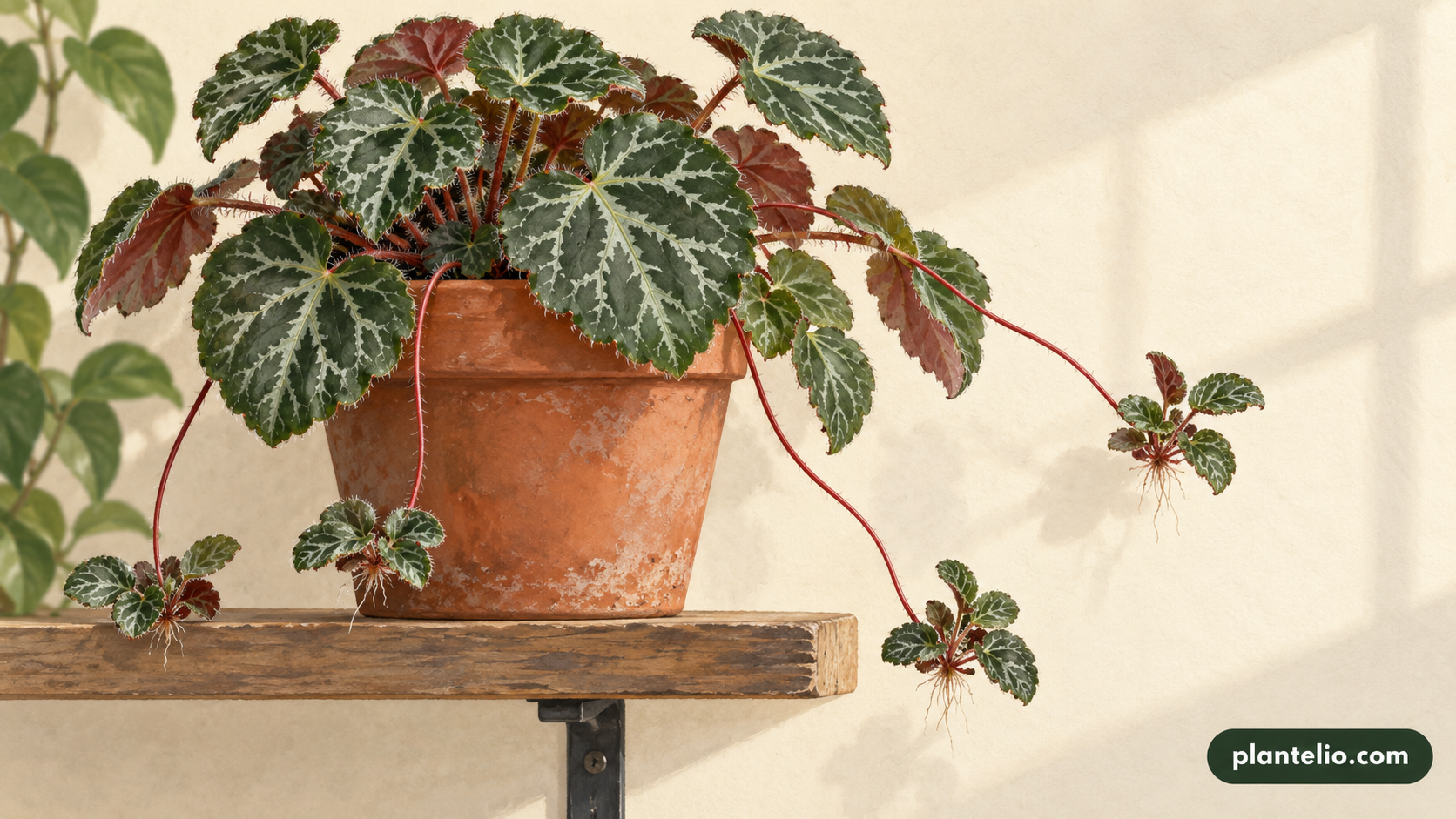
Strawberry begonia care starts with the botanical name: Saxifraga stolonifera. Despite its common name, this is a saxifrage, not a fruiting strawberry or a true begonia. Its thin red runners are a normal part of its growth, often carrying small plantlets beyond the main pot.
Make room for the runners
RHS describes rounded, hairy leaves with silver veins above and reddish undersides. Long red stolons carry new rosettes, giving the plant a trailing display even though the main foliage forms a low clump. A raised pot can show this habit without forcing the runners into a crowded shelf.
Before choosing a position, consider the space below the container as well as its width. Keep the runners clear of drawers, cupboard doors and frequently moved objects. You should be able to lift the pot for inspection without catching the plantlets on neighboring items.
Use indoor light guidance
NC State recommends bright, indirect light indoors. Its outdoor shade advice describes a different setting, so do not assume a dark indoor corner will provide equivalent light. Our bright indirect light guide helps you evaluate the actual location.
A red leaf underside is part of the plant’s normal appearance. Assess new discoloration against healthy leaves on the same specimen rather than treating all red coloring as damage.
Keep the medium moist and draining
NC State recommends moist, organically rich, well-drained soil. For a houseplant, that means paying attention to the root-zone condition rather than adding water whenever a runner looks thin. Use our soil moisture checking routine to assess the pot before watering.
A pot’s decorative appearance tells you little about its drainage. Make the watering arrangement easy to inspect, especially when a hanging display hides the base of the container.
Plantlets offer a propagation option
NC State notes that plantlets can be rooted directly in soil. RHS also lists separating individual rosettes as a propagation method. This is different from trying to grow a new plant from an arbitrary piece of runner with no rosette attached.
You do not need to propagate every plantlet. Decide whether you want a fuller trailing display or a few new plants, and leave enough working space around the parent pot. Keep the botanical label with any plants you share.
Sources: NC State Extension: Saxifraga stolonifera; RHS: creeping saxifrage.












Post Comment